Been making socks again! "Silver Fox:20 day socks"(yes they did take 20 days to make, including prep and spinning) for husband's birthday, and "Beltane socks" for me. Used my usual method of knitting socks: from toe up, using provisional cast on at the base of the toes, short rows/ wrapped stitches for the heels and toes. The Silver Fox's have twisted rib in the cuff (knitted and purled into the back of the stitch) with an invisible bind off, which I still have to look at the instructions for everytime I do it, until I get into the swing (about halfway around the sock cuff!)A really stretch cuff was the result. As with the Beltane's, I kept the cuffs chunky just by staying on the same size of needle. The Beltane's have just a standard k1 p1 rib with a standard cast off too.
So both of these socks were made from a chain plied yarn. I'm so pleased I learned how to do chain plying, I use it alot. It's advantages in these socks are that you can keep different coloured areas of a many coloured singles seperate (if you are using one continuous multiple coloured braid, the colours work very similarly in the yarn to the original beauty of the fibres), and the yarn becomes a nominally 3 ply, making it harder wearing than a 2 ply. Additionally, you get a nice round yarn because of the 3 plies.
The Silver Fox socks are spun entirely from au natural UK wools. From the toe up these are: Black Jacobs, Black Hebredien, Coloured Texel, Oatmeal Blue faced Leicester. I aimed to subtley blend them to get a graduated colour change, which mostly worked ok. You actually can't do this too much! Somehow any "leap" in colour graduation becomes more pronounced when it's spun up into a yarn, so even if it's just a rolag or 2 per shade, really working on those subtle colour blends at the prep stage pays off in the end.
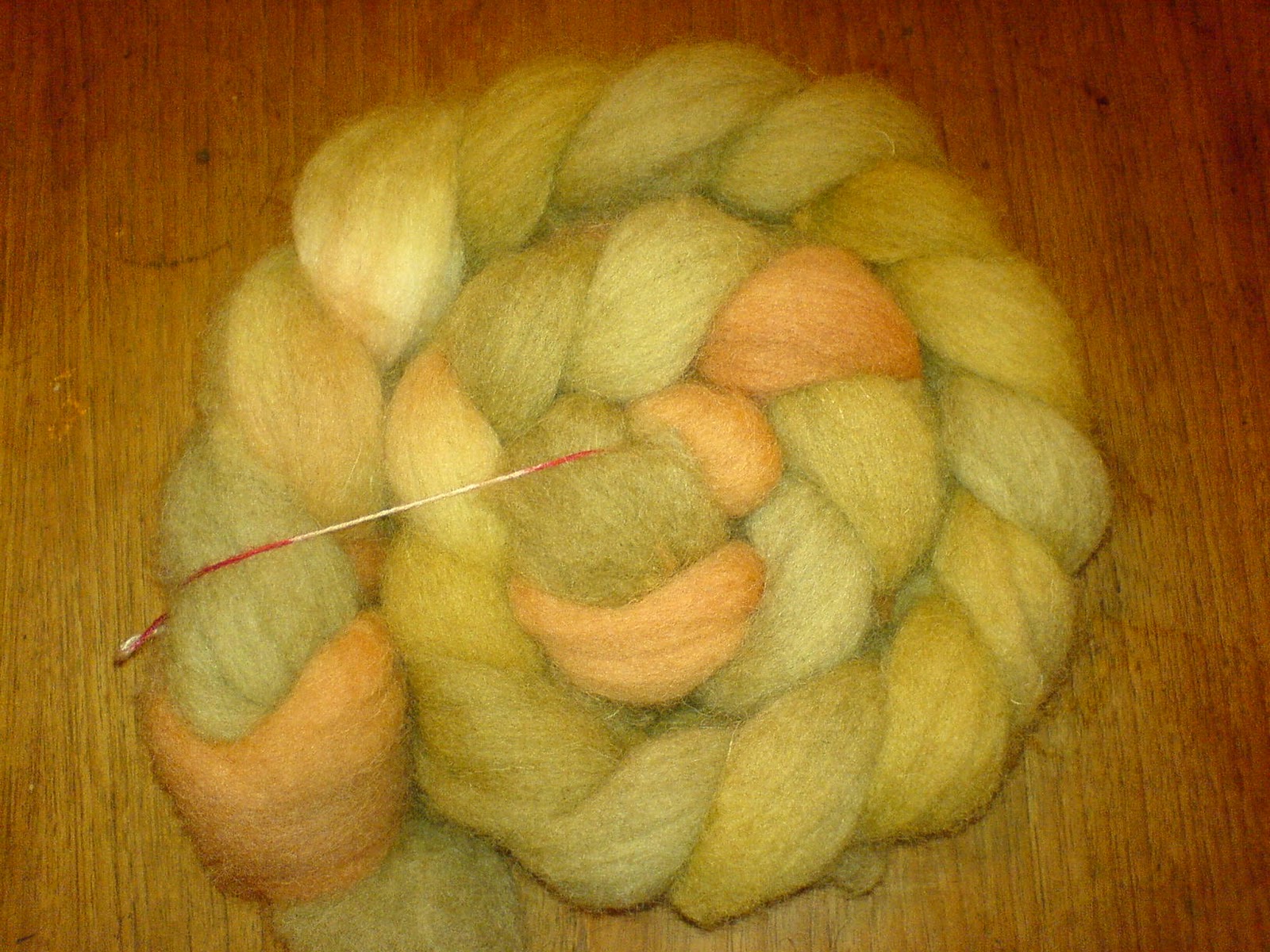
The Beltane socks, above, were spun mostly from 2 lengths of white shetland tops I dyed up with some artisan threads natural dyes I was given in UK Spinners secret santa. I also overdyed some moorit shetland , a tiny bit of tussah silk and some wensleydale, which take up the dye differently to the white shetland, and added these bits in, sometimes blended in, sometimes just spun in as they were. I felt these one's had a kind of Noro-ish look to them, but ofcourse they have the advantage of being 3 ply, and not singles, so they may wear better....
About this blog space
This blog space is a place for me to primarily put all my wool gatherings, adventures, experiments. I am now a mum of two astounding daughters, and I used to be a DIY musician and co-ran a tiny independent label (Slampt), so this punk can-do attitude plus feminist analysis and Art school experience somehow informs my wool work! I am also deeply moved by GREEN, trees, weather, colour combinations in nature, and texture. I aim to source wool from round the corner or at the very least UK grown and processed, and to create no toxic waste. This means I get to see sheep as often as I can, sometimes at wool fests.
I am on Ravelry and Etsy as FatHenWildWool and Facebook as Rachel Holborow.
Showing posts with label spinning. Show all posts
Thursday, 31 May 2012
Wednesday, 18 May 2011
New fleeces!
How very exciting! I've had some new fleeces given to me AND swapped some via the UK Spinners Ravelry swap.
I got given 2 black hebredians and one white mystery fleece, which I'm slowly processing, and in the swap received some black Alpaca, mule (BFL x), coloured wensleydale and moorit shetland. So far i only have spun a little of the hebredian (to sample it) and the black Alpaca.
The Hebredian was lovely and soft and bouncy and I made it into rolags and longdraw spun it. The Alpaca was such a different story though. It's really short staple and slippery with no crimp, so in the end I spun it from the fold on a 7:1 ratio, slow draw in. It's come out uneven, and a bit ropey, but I suspect it will drape well: Hebredian bottom: Black Alpaca top.
I got given 2 black hebredians and one white mystery fleece, which I'm slowly processing, and in the swap received some black Alpaca, mule (BFL x), coloured wensleydale and moorit shetland. So far i only have spun a little of the hebredian (to sample it) and the black Alpaca.
The Hebredian was lovely and soft and bouncy and I made it into rolags and longdraw spun it. The Alpaca was such a different story though. It's really short staple and slippery with no crimp, so in the end I spun it from the fold on a 7:1 ratio, slow draw in. It's come out uneven, and a bit ropey, but I suspect it will drape well: Hebredian bottom: Black Alpaca top.
Saturday, 5 March 2011
Grass and docks as dye plus Secret santa yarn
This top fibre is a recent experiment in plant dye colours. As always I am on the search for ways to obtain greens. I don't know exactly why I'm so obsessed with that colour, but perhaps it has to do with chakra colours! The green chakra relates to the chest/ heart area, and as I understand it the area of the body concerned with being open hearted and love. But maybe green just makes me happy!
Anyway, so to get the greenish yellow in the photo, I used dock roots, freshly dug from the allotment in a hope of having fewer docks scattering their seeds over my veg patch this year. These I cut up quite small and let steep in rain water for a few days. Then I remembered about them, and simmered the pot for about 40 mins on the stove. Then later that day I re-simmered them. Then I let them rest over night, and re-simmered them. Then, when the mixture had cooled, I strained out the veg matter, and mud, and inserted the wetted wool (Texel in this case for sox spinning) I heated the wool in the mixture 2 times in a similar fashion to extracting the colour from the dock roots.I added the juice of 2 lemons before heating. I let the wool rest in the dyepot over night. The crucial thing is to get as much colour as poss out of the docks, then to get as much as poss into the wool, without felting it. This takes as long as it takes, and letting the wool rest in the mixture is very much part of it!
Extracting and dyeing with the liquid from the grass was a very similar process to the dock roots, but the heated up grass REALLY STANK the HOUSE out! I don't know WHAT is in grass to make it so smelly when cooked but it honestly smelled of carnivore excrement. Yuck! My husband and the kids were NOT impressed. However, Fay was very keen on having the finished fibre when it was all dry and fluffy and not smelly.... In the photo the colours look more vibrant than they do in cloudy daylight, as they were taken on our table at night under artificial light.
The other photo is WHAT I SPUN from the secret santa fibre I received from the UKSpinners on the Ravelry forum.(see a previous post). It was blended with various reds and silky noils and throwsters waste etc. None of the baby batts were more than 50% red. I'm currently really interested in how green combines with other colours, but especially reds. There is an exciting section with cocoons spun on, which I loved doing! It's a soft, slightly overspun, singles of 16 WPI (fingering weight). And I am currently intending to knit it into a cowl in the round. I am hoping that it's slightly overspun quality might make the stockingette twist a little, but I don't know if that happens after you've set the twist?
Labels:
blending,
docks,
drum carder,
Grass,
plant dyeing,
singles,
spinning,
wool
Subscribe to:
Posts (Atom)