This has been our recent Nature Table ( a Steiner tradition for bringing the seasons into the house (ours is a shelf)). The main feature of it is the figure of King Sun, who is a little dry felted chap. He has pipe cleaners as a skeleton for his arms and head shape but otherwise is just made of wool scraps needle felted together.You have to make sure the bottom is well felted and sturdy, so he can stand up. Sometimes I add a pebble to weight it but didn't this time.. He has a copper crown in this representation, which seemed highly appropriate to me: it's just a scrap of copper electrical wire made ziggy zaggy, although Mr Pexton in the hardware shop cut his finger getting the wire out of a thicker one for me. Apparently pure copper wire is hard to come by these days...
The butterflies are also dryfelted, and seasonal Brimstones and Blues, which I often see walking through the Allotment to school. The fire is just wisps of wool tops as flames.
This Summer solstice time of the year has "St John's festival" in the Steiner tradition, which at our school is a high energy run or walk for each individual between or over flame. I feel this as a cleansing, and the children are encouraged to throw their grumbles and gripes into the fire as well. It also acknowledges the individual as part of a group, similarly to the twelve candles of whitsun.
St John is John the baptist, he of the severe wandering and asetic life. I myself see this time of year as being characterised by male energy such as the Holly King / Oak King celtic pagan legend, and it's also lovely to see bright firery colours amongst the blooms of the season. The blooms are (or symbolise) perfectly the Airy nature of summer, where all is most "out There". We all find ourselves a bit scatty and "air heady", and young children often "excarnate" letting their energies float free of the physical body, but also seem to find it excruciating to sit still, the want to zoom about like all the animals, like the pollen and insects floating free in the air.
Colours of the season: yellow, red, orange, bright pink, pale bright blue, green and maybe some earthy brown, so we don't float right off!
Symbols: Zig zags, spirals, golden suns, white doves
I made the King Sun figure as part of a Seasonal workshop I was hosting, which was wonderfully inspiring. I felt blessed to be in room with so many women given just the space, materials and opportunity to create amazing seasonal characters.
About this blog space
This blog space is a place for me to primarily put all my wool gatherings, adventures, experiments. I am now a mum of two astounding daughters, and I used to be a DIY musician and co-ran a tiny independent label (Slampt), so this punk can-do attitude plus feminist analysis and Art school experience somehow informs my wool work! I am also deeply moved by GREEN, trees, weather, colour combinations in nature, and texture. I aim to source wool from round the corner or at the very least UK grown and processed, and to create no toxic waste. This means I get to see sheep as often as I can, sometimes at wool fests.
I am on Ravelry and Etsy as FatHenWildWool and Facebook as Rachel Holborow.
Wednesday, 29 June 2011
Saturday, 18 June 2011
Ethics and natural dyeing; complexity
Top: Cumbrian Blue Faced Leicester wool locks, cleaned with eco washing powder, by me, then dyed with wild harvested Horseradish, onion skins from the wholefood shop, and madder from?
Bottom: Blue Fcaed Leicester, some commercially processed, some by me, as above, dyed with black beans from? onion skins, goldenrod from UK, and indigo from?
Recently received "Eco Colour" by India Flint in the post: Sustaining soul food for the natural dyer who is trying to pick the most ethical way through to coloured fibres. Afferming and at times eye opening, it's wonderful to come accross a person who makes an ethical approach into an Art via spirit and joi de vivre.
Helped me to focus thoughts feelings actions I've been having about my dyeing works in that I've realised using "findings of the forest floor" is the most comfortable path for me to amble on. Whether I can "give it up" to my results being entirely happenstance remains to be seen.
Methods I question as to being comfortable for myself which India uses: Uses of found metals as mordants/resists: I'm happy with copper (probably beneficial to a body), and possibly iron if dye dregs are thoughtfully treated, but I'm seriously unkeen on Aluminium (surely a link to alzheimer's?):The use of a microwave: I'm never happy with irradiating anything, it's a crime against life itself! Not to mention the high probablity of leaks right into your living space. And then there's Microwave disposal when it's done, it's all too much!
What was really useful was her critiquing of the Logwood and Indigo industries: I guiltily admit to uninformed use of Logwood!(see earlier blog). It is nourishing for me for someone to turn the ethical spotlight onto the natural dye industry, and then prove it's how unnecessary compromised ethics are so eloquently with her wonderful colours. I also love that she questions the use of synthetic dyes so completely: You've probably heard the discussion: Q:Plant dyes are not permenant, so why waste your time using them? A: Some are very long lasting, but ALL dyes fade anyway, as we know from experience (and indeed on my own pootles around Ravelry etc I've certainly noticed complaints of synthethic dyes running, fading and even changing colour!)
Regionalism is also an approach close to my heart: blues from local cabbages just seems so much kinder than indigo from who knows where flown accross the world to my dye pot.
Sometimes, if you talk about the "ethics" of something people will start pointing the finger at you, and try to prove that you are unethical because of some crime once commited. I write this blog post in the spirit of one searching out a path less travelled, who does so because that feels the most sound path to travel. I'm sure there will be many false turnings, and perhaps some unforseen difficulties ahead, but the path of Adventurer in Ethical Colours for Wool I claim as mine to tread! I aim to get better at it one step at a time...
Saturday, 4 June 2011
Solar dyeing and tour de fleece
What a wonderful thing a sunny half term is: it has meant that I have been able to indulge myself with solar dyeing some wool and to "get in training" for the Tour de Fleece on Ravelry. I am slightly part of Team UK and our set training this week is to spin and ply a Chain Ply yarn, of whatever length. I took this as an excuse to blend some delicious baby batts on the mini drumcarder ( from predyed merino, recycled sari silk, a dash of soya fibre and red angelina) and then spin it from the fold. Halfway along I felt the urge to try spinning from the fold LONGDRAW, which I managed with ease. That's never clicked before, but I think the fluffy batts helped with that. I was really pleased with the resulting squidgey yarn, something I don't normally manage when Chain Plying. Although in the begining I didn't manage to put quite enough twist in for it to hold together in the ply, I soon worked that out. So there is a funny improvised patch in the middle of the yarn that I will probably cut out when I come to knit it.
My treadling is improving, as I could go really SLOW when I needed too for the chain ply action.
The fantastically warm sun in our backyard has meant I've been able to do some SOLAR DYEING which I love it's so easy and you don't use up any energy except your own (slight) and the abundant sun's. For the bluey greys and pinks I used lacs and black beans, put in a plastic bag ( NB No holes!) after mordanting with mouldy rhubarb stems (oxalic acid). I dribbled patches of lac dye directly onto the wool in the bag, then patches of black beans too. I topped the bag up a little with some water, so the wool was covered, and tied it tightly. I put it on an old baking tray and sat it in the sun for 2 days. One of the advantages of solar dyeing is that you have much less chance of felting, it's also really unmessy. I've had great results with doing it in jars too. Inside the containers it gets really hot: steam results! I've used a photo of the jars, as it's much more photogenic than an old plastic bag....
My treadling is improving, as I could go really SLOW when I needed too for the chain ply action.
The fantastically warm sun in our backyard has meant I've been able to do some SOLAR DYEING which I love it's so easy and you don't use up any energy except your own (slight) and the abundant sun's. For the bluey greys and pinks I used lacs and black beans, put in a plastic bag ( NB No holes!) after mordanting with mouldy rhubarb stems (oxalic acid). I dribbled patches of lac dye directly onto the wool in the bag, then patches of black beans too. I topped the bag up a little with some water, so the wool was covered, and tied it tightly. I put it on an old baking tray and sat it in the sun for 2 days. One of the advantages of solar dyeing is that you have much less chance of felting, it's also really unmessy. I've had great results with doing it in jars too. Inside the containers it gets really hot: steam results! I've used a photo of the jars, as it's much more photogenic than an old plastic bag....
Sunday, 29 May 2011
Fleece Swap cobweb weight
Phew! I've been testing my limits with this yarn: It's turned in at 26 Wraps Per Inch officially a cobweb weight, and it's spun from a Blue faced Leicester X (mule) wool fibre prepared by Someone? in the UK Spinners Ravelry Fleece Swap into a fluffy batt with a little bit of slubbiness. I was sent 50 grams of this in the Fleece Swap and I've only spun about half that. It was lovely to spin, but why did I choose to spin it so fine? Well I was testing out my smaller whorl on my Traddy flyer, and with the fibres of this batt being so long it worked out I could do this with it. ( The ratio was 12:1). It's silky and shiny. I'm hoping to spin the rest of it sometime, but colour is calling me right now....
Wednesday, 18 May 2011
Dyeing, dyeing, dyeing
Somehow it always seems wrong to write dyeing, the "e" really feels like it shouldn't be in there. But hey, the vaguaries of the English language....
Anyway. Done alot of dyeing. All onto Blue faced Leicester. All with natural dyes using mordants such as vinegar, lemons, alum: From top base of golden rod overdyed with lac and madder. Nettles, black beans and onions. Lac, onions and cutch. Onions, beans, golden rod. Beans with alum. Cabbage and onions and dandelions. Will write more about some of these sometime soon.........
New fleeces!
How very exciting! I've had some new fleeces given to me AND swapped some via the UK Spinners Ravelry swap.
I got given 2 black hebredians and one white mystery fleece, which I'm slowly processing, and in the swap received some black Alpaca, mule (BFL x), coloured wensleydale and moorit shetland. So far i only have spun a little of the hebredian (to sample it) and the black Alpaca.
The Hebredian was lovely and soft and bouncy and I made it into rolags and longdraw spun it. The Alpaca was such a different story though. It's really short staple and slippery with no crimp, so in the end I spun it from the fold on a 7:1 ratio, slow draw in. It's come out uneven, and a bit ropey, but I suspect it will drape well: Hebredian bottom: Black Alpaca top.
I got given 2 black hebredians and one white mystery fleece, which I'm slowly processing, and in the swap received some black Alpaca, mule (BFL x), coloured wensleydale and moorit shetland. So far i only have spun a little of the hebredian (to sample it) and the black Alpaca.
The Hebredian was lovely and soft and bouncy and I made it into rolags and longdraw spun it. The Alpaca was such a different story though. It's really short staple and slippery with no crimp, so in the end I spun it from the fold on a 7:1 ratio, slow draw in. It's come out uneven, and a bit ropey, but I suspect it will drape well: Hebredian bottom: Black Alpaca top.
Sunday, 8 May 2011
spinning, carding, plying release.
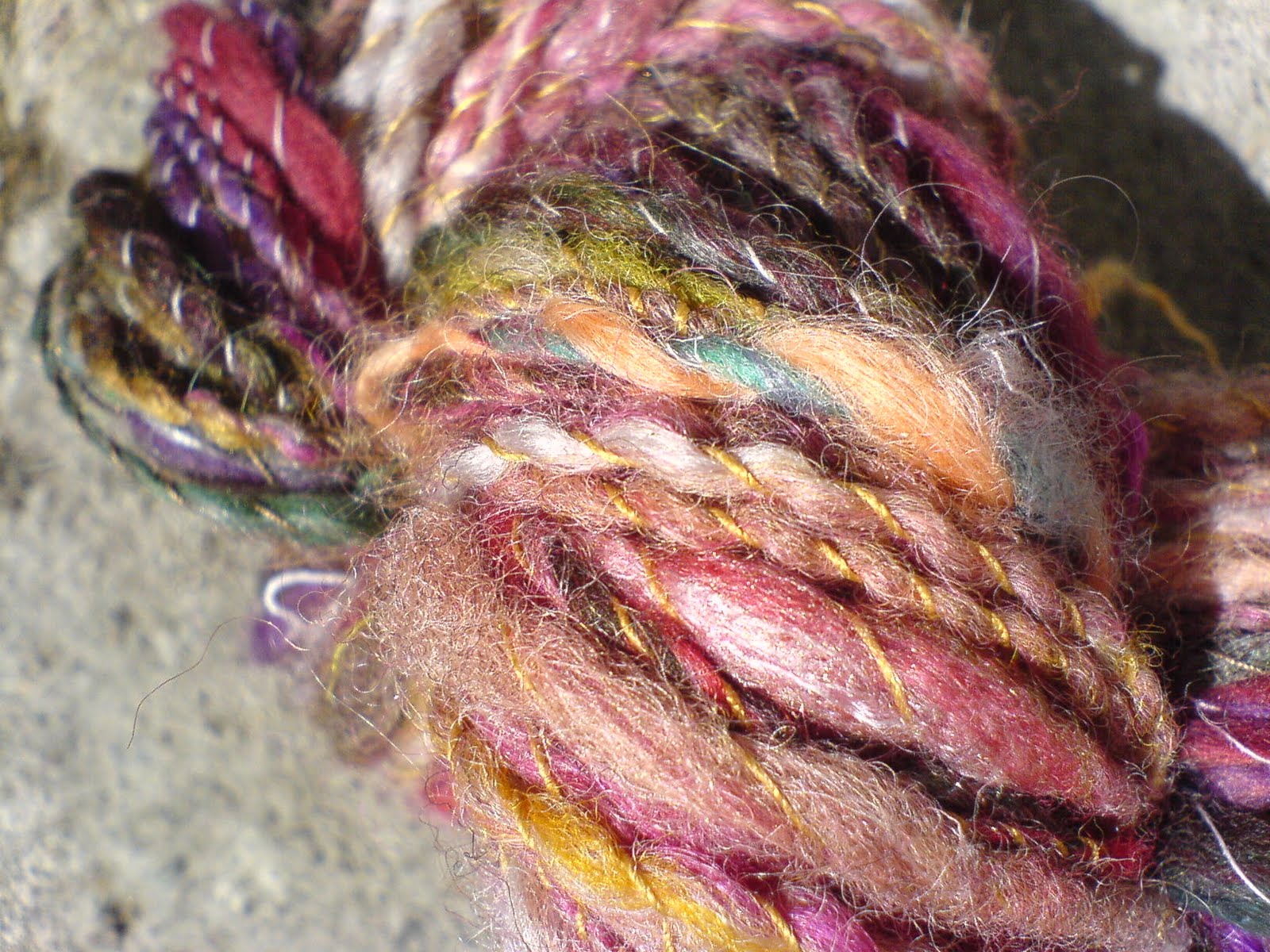
The above pix are all of a yarn I recently spun for my good friend Cath's birthday. It was a big release making it, as apart from colour scheme it was a blank canvas for my imagination to run free.
I've been working on stuff for the York Steiner School Craft group, as we've got Spring Fair coming up, and also being quite specific about what I want the outcomes to be for what I spin, so it's lovely to let my hair down and have some fun with a yarn.
We started a Family Spinning Group at Grace and Jacob (Walmgate, York, Last Saturday of the month), and Fiona, the shop owner, let me loose on her drumcarders last time, so I made the batts that much of this yarn was spun from.Only once blended. Lovely fluffy, squidgy big batts, one made on a Louet, the other on a Barnett. (Think I prefered the Barnett, as it was easily adjustable and had smaller springier teeth. I suspect a more even blend will be possible with it than the big industrial teeth of the Louet, but would probably need DAYS of time and KILOS of fibre to play with to really be sure...)
Cath is fond of pinks and reds aswell as black, so I spun up a squidgy thick thin single and thought I might ply it with a thinner single of naturally black shetland. However when it came to it I decided on gold stitching thread, mostly because I wanted an exagerated "bumpy" plying effect, but also a bit of "bling" that might pull the at times disparate colours together; black might be too bold and distracting from the colour graduations too, especially when knitted up. A warm colour of a quite intense saturation seemed the thing. (I did unfortuantely run out of the gold, and had to use a very similarly toned brown, and then pale pink to complete the ply. The brown works better than the pink in my view). Cath was, in her words "delighted" with the yarn.
Location:
York, UK
Subscribe to:
Posts (Atom)